
AustinVestors resources
Austin Landlord Report: August 2026 Rental Market Update
August 2026 Austin rental market data, including median rent, leasing activity, inventory, days on market, and practical guidance for Central Texas landlords.
Austin rents are stable, but fewer homes are leasing
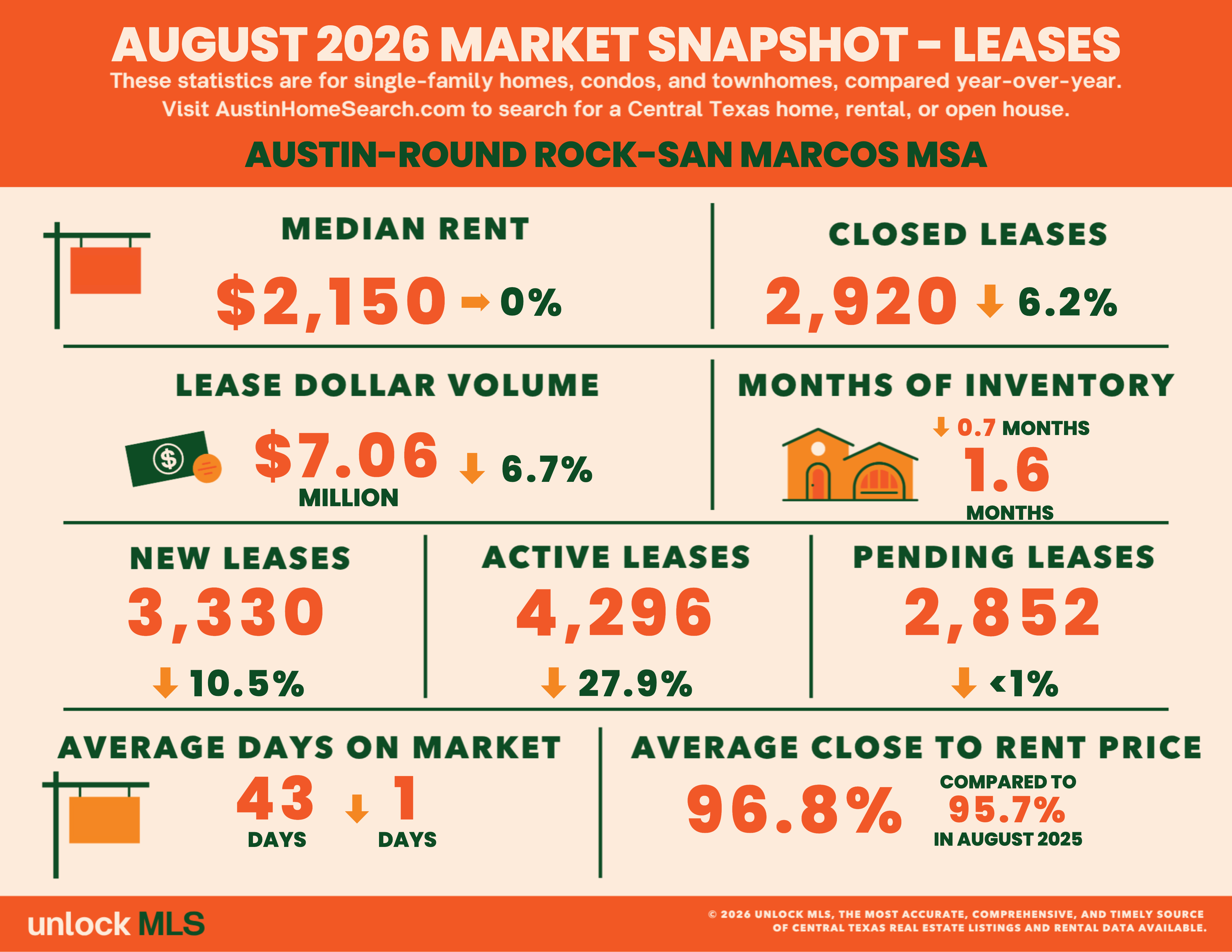
Austin-area rents remained stable in August, but fewer rental homes changed hands than they did one year earlier. According to the August 2026 Unlock MLS market snapshot, the median rent for single-family homes, condominiums, and townhomes across the Austin–Round Rock–San Marcos metropolitan area was $2,150—unchanged from August 2025.
Closed leases fell 6.2% year over year to 2,920, while total lease dollar volume declined 6.7% to $7.06 million. New leases were down 10.5%, and pending leases were nearly flat, decreasing by less than 1%.
For Austin landlords, the headline is not that demand has disappeared. It is that renters remain selective, and each property must be positioned carefully for its neighborhood, price range, condition, and competition.
Correct pricing protects annual rental income
The average property leased for 96.8% of its advertised rent, up from 95.7% in August 2025. On a home listed at $2,500 per month, a 3.2% difference equals approximately $80 per month, or $960 over a 12-month lease.
That gap reinforces the importance of launching at a market-supported price. An owner who holds out for an additional $100 per month but loses a full month to vacancy may give up $2,000 to $3,000 or more in rent before accounting for utilities, lawn care, make-ready work, and other carrying costs.
Pricing decisions should rely on recently completed leases, current competing rentals, the home’s condition and amenities, seasonal demand, showing activity, and applicant feedback. Active listings alone show what other owners are asking—not necessarily what renters will pay.
Lower inventory does not guarantee a quick lease
The Austin metro reported 1.6 months of rental inventory, 0.7 months below the prior year. Active leases also declined 27.9% to 4,296, indicating that renters had fewer available options than they did in August 2025.
Even with tighter inventory, the average rental spent 43 days on the market. That was one day faster than last year, but it still represents more than six weeks of potential vacancy for the typical listing.
Lower inventory can support well-positioned properties, but it does not eliminate differences between submarkets. A central Austin condominium, a suburban single-family home, and a rental in Hays or Williamson County may experience very different demand during the same month.
Presentation and responsiveness help properties compete
Prospective residents frequently compare multiple properties online before scheduling a showing. Professional photography, an accurate description, transparent total monthly pricing, curb appeal, cleanliness, and a complete make-ready can materially affect inquiry volume.
Showing availability and timely follow-up also matter. Qualified applicants may be considering several homes at once, so avoidable delays can send a strong prospect to a competing rental.
Owners should watch the first one to two weeks of marketing closely. Few inquiries may point to a pricing or presentation issue, while inquiries without showings or applications may indicate concerns about condition, access, qualification requirements, or overall value.
Resident renewals can protect investment performance
When new-lease activity slows, retaining a dependable resident becomes even more valuable. A successful renewal may avoid vacancy, cleaning, repairs, professional marketing, leasing expenses, and the uncertainty of replacing a proven resident.
Renewal decisions should consider current market rent, resident payment and property-care history, upcoming maintenance, lease timing, and the likely cost of turnover. The highest possible rent is not always the most profitable annual outcome.
Proactive maintenance and clear communication also support retention. Resolving concerns promptly can improve the resident experience while protecting the property from small issues that may become larger expenses.
What Austin rental owners should do now
Owners preparing to lease a home should begin with a property-specific rental analysis rather than a broad metro average. Price the home against the most relevant recently leased and currently competing properties, then establish in advance when marketing performance will be reviewed.
Complete repairs, cleaning, landscaping, and photography before the listing launches whenever possible. Present rent, required monthly charges, deposits, and application requirements consistently so prospects can evaluate the true cost of the home.
For occupied properties, begin renewal planning early enough to compare the economics of retention and turnover before notice deadlines. A modest, well-supported renewal adjustment may outperform a larger increase that leads to avoidable vacancy.
The bottom line for Austin landlords
August’s data describes a stable but selective Austin rental market. Median rent held steady, inventory tightened, and properties leased slightly faster, yet closed leasing activity and total volume declined from the prior year.
Owners are best served by focusing on total annual performance rather than advertised rent alone. Accurate pricing, professional presentation, responsive leasing, careful screening, proactive maintenance, and thoughtful renewals remain the strongest tools for reducing vacancy and protecting long-term returns.
AustinVestors helps rental owners throughout the Austin metropolitan area evaluate rent, prepare properties for market, secure qualified residents, and manage the complete resident lifecycle with a dedicated portfolio team.
Put local experience behind your Austin rental.
Talk with AustinVestors about pricing, leasing, maintenance, and full-service management.