
AustinVestors resources
Austin Landlord Report: What June 2026 Rental Data Means for Property Owners
June 2026 Austin rental-market data and practical guidance for landlords navigating rent pricing, longer marketing times, vacancy, and resident retention.
Rents are holding, but leasing is taking longer
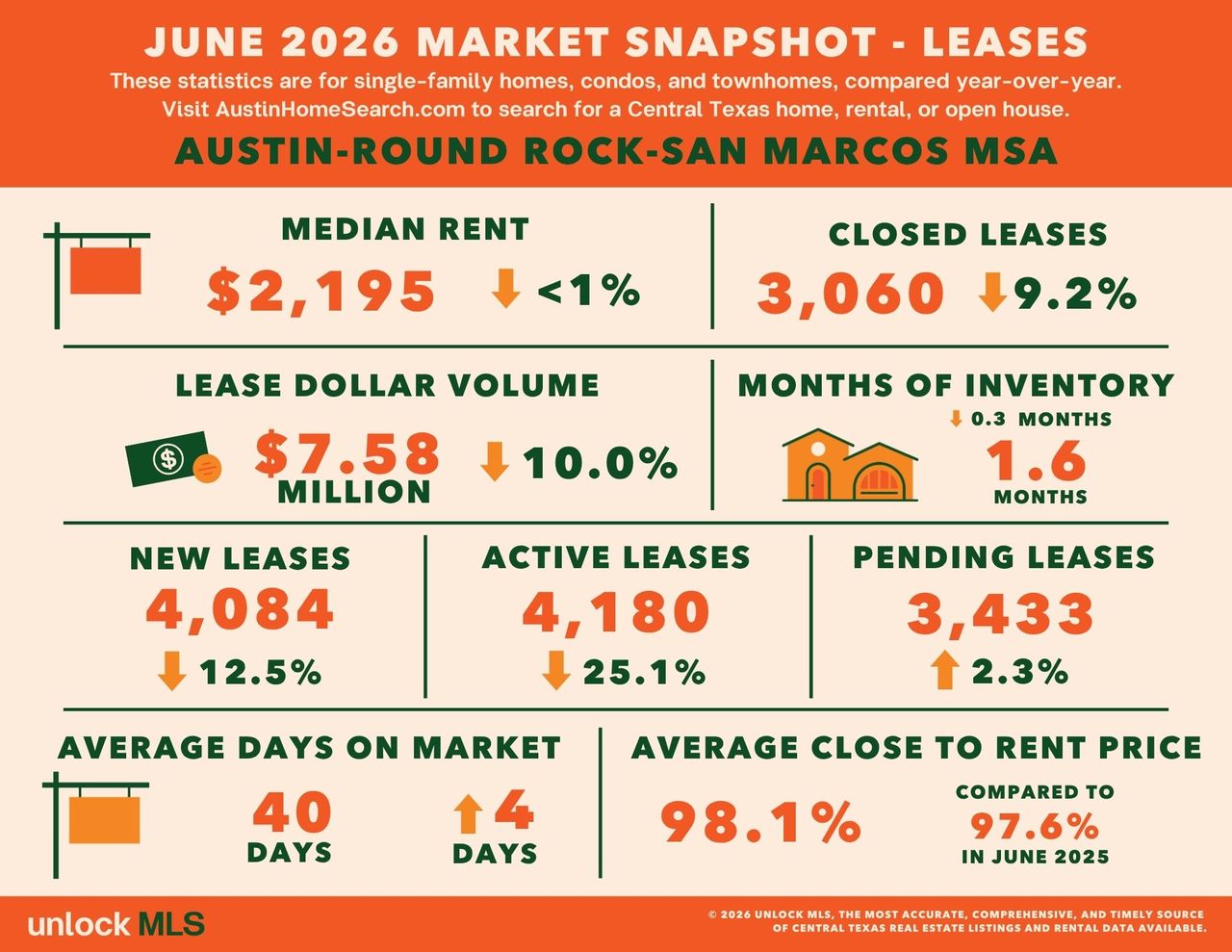
Austin-area rents remained relatively stable in June, but leasing activity slowed and rental homes took longer to secure residents. According to the June 2026 Unlock MLS market snapshot, the median rent for single-family homes, condominiums, and townhomes in the Austin–Round Rock–San Marcos metropolitan area was $2,195—less than 1% below June 2025.
Stable rent prices are encouraging, but they do not tell the entire story. The average rental spent 40 days on the market, four days longer than it did one year earlier. For property owners, those additional vacancy days can matter more financially than a small difference in the asking rent.
At the June median, each vacant day represents roughly $72 in potential rent. Waiting too long to respond to limited interest can quickly cost more than making a modest, strategic pricing adjustment.
Accurate pricing is increasingly important
Austin-area rentals closed at an average of 98.1% of their advertised rent, an improvement from 97.6% in June 2025. This indicates that appropriately positioned properties are still leasing relatively close to their asking prices.
It does not mean owners should begin with an aggressive rental rate. An overpriced home may receive fewer inquiries, accumulate additional days on the market, and eventually require a reduction. The strongest pricing strategy considers recent comparable leases, current competing rentals, the property’s condition and amenities, and applicant response during the first days on the market.
The market provides valuable feedback. Low inquiry volume may indicate a pricing or marketing problem, while inquiries without applications could point to property condition, showing availability, qualification standards, or perceived value.
Leasing activity has slowed
Closed leases declined 9.2%, while total lease dollar volume fell 10% from the previous year. The number of new leases shown in the snapshot also decreased 12.5%.
These figures indicate that fewer leasing transactions were completed than in June 2025. At the same time, pending leases increased 2.3%, showing that renters remain active.
This is not a market without demand. It is a market in which prospective residents may compare their options carefully and owners benefit from a deliberate leasing strategy.
Reduced inventory creates a mixed market
The market reported 1.6 months of rental inventory, a decrease of 0.3 months from the previous year. Active leases were also down 25.1%, according to the Unlock MLS snapshot.
Lower availability can benefit owners because residents have fewer competing homes from which to choose. Nevertheless, the longer average marketing time shows that limited inventory does not guarantee a quick lease.
Rental performance can vary substantially by neighborhood, price range, property condition, school district, and home type. Metropolitan statistics establish context, but every property still requires an individualized analysis.
Price and present the property for today’s renter
Rental values should be based on recently completed leases and current competition—not only active listings, last year’s market, or the owner’s expenses. The first one to two weeks of marketing usually provide the clearest feedback, so limited interest should prompt a timely review of price and presentation.
Professional photography, cleanliness, curb appeal, working fixtures, neutral presentation, and prompt repairs all influence a prospective resident’s perception of value. Marketing should clearly explain the property, its amenities, qualification requirements, and total monthly price.
Convenient showings and responsive follow-up also matter. Qualified applicants frequently consider several homes at once, and unnecessary delays can cause an owner to lose a strong applicant to a competing rental.
Protect resident retention and evaluate vacancy as an expense
When marketing periods lengthen, retaining a responsible resident becomes even more valuable. Proactive maintenance, clear communication, appropriate renewal pricing, and timely renewal discussions can help reduce avoidable turnover.
Owners should compare a proposed rent increase with the possible costs of vacancy, cleaning, make-ready work, marketing, leasing, and an uncertain replacement timeline. The highest advertised rent does not always produce the strongest annual result.
Vacancy should be evaluated as a real operating expense. Holding out for a slightly higher rent may reduce annual income when the additional vacant days cost more than the increase eventually achieved.
The bottom line for Austin rental owners
June’s data shows a balanced but increasingly selective Austin rental market. Median rent remains stable, and properties are leasing close to their advertised prices. However, completed leasing activity is lower and the average home is taking longer to lease.
Success in this environment depends on executing a complete leasing strategy: accurate pricing, professional presentation, responsive communication, accessible showings, careful screening, and timely adjustments.
AustinVestors helps property owners throughout the Austin metropolitan area position their rentals competitively, reduce avoidable vacancy, and protect the long-term performance of their investments.
Put local experience behind your Austin rental.
Talk with AustinVestors about pricing, leasing, maintenance, and full-service management.